Franco E. Pacho
Recently, I’ve been thinking about portfolios, more specifically on how we build one. Since I am in the process of updating my writing portfolio.
By now, if you are aiming to work at the gaming industry you must have heard (and read, even here at ENTRY LVL) some advice to build your portfolio or perhaps attended Portfolio Reviews. If not…, do it. RIGHT NOW.
The most common advice you get is “Show your best pieces”, “Work in various pieces as a unified project”, and “Show complete breakdowns”.


Usually, the resume of the advice is “you must present a detailed version of what you can do while aligning what you are showcasing with the expected work of where you want to apply”, so you get more hits than misses; that and a good amount of luck.
And this is all advice that many can understand when it comes down to Art portfolios, since this is where the portfolio idea mostly comes from. Animation, Concept Art, also applicable to 3D.
But this does not translate well to some other Game Dev disciplines.


I approached my Narrative portfolio with this mentality. I wrote an interesting character, their Bio, their mechanics and how the player interacts with them, wrote barks and some dialogue. And then when I received feedback for it, I was hit with “This would be an automatic failure for any writer test you do”.
The reason: This character did not consider the limitations of systems and game design needs. This character spoke like this: “I/We are pleased with your help/service”. They told me this would be confusing, and if there were the plans for this character to have voice over, there would be complications on how to approach it for voice acting.
So, I had to dial the complexity back, rethink how the character I have already designed and rethink their voice. Same thing with the place where the player would encounter them. This was new to hear for a portfolio.
Not do you most complex pieces? Think of your budget?
When it comes to Design at least for Game, Narrative, Level, I learned a new advice for portfolio. Show you clearly know how “games work”.
1.Be mindful of UI
…like the number of words in each dialogue box or how you make a player clearly understand effects through clean and neat icons while traversing levels.
2. Be mindful of UX
The processing of information you give to each player, or how to dial up or down tutorials and pop ups so they don’t feel you are hand holding them, how you communicate this information.
3. Technical budgets
…since you can’t design epic pieces with crowds that would most likely crash your computer.
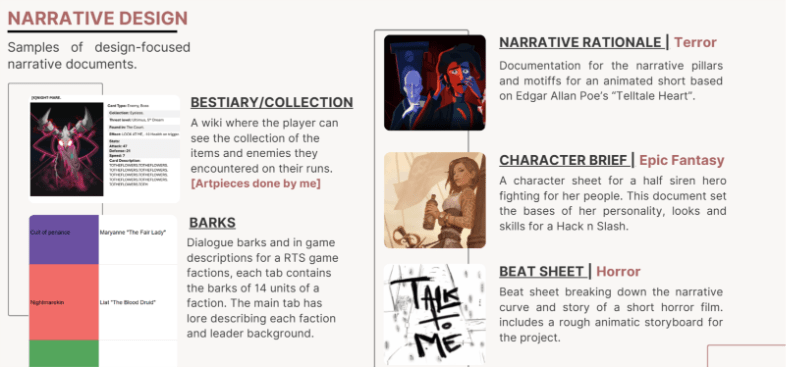
Example of a pretty looking but not so functional portfolio (my old one)
The breakdowns were completely different too, in Art portfolios, some notes and materials breakdowns with some timelines are great and explains the artist thought process when the art is done.
Breakdowns on design must show what you are trying to convey to the player in real time. And a lot of the times a portfolio for design roles will have screenshots of the behind the scenes with explanations of why the decisions were taken, sometimes it feels wrong since putting literal excel sheets on with ramblings of a eloquent concise madman.
I’m sharing this for anyone that has a great looking portfolio but with not-so-great explanation and thought process of the design choices taken. Try and look for points of your work when shows things a little too out for a budget you are aiming for things that shouts “Naughty Dog”, but you are applying to “We-are-3-people-and-a-dog” indie studio.

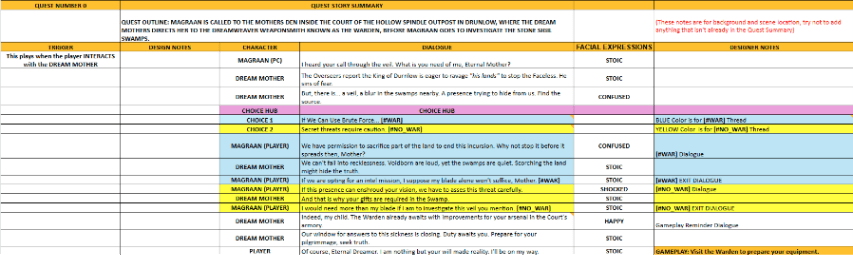

Start thinking how to replace just great pieces with great pieces that have actual thought on the collaborative effort of games. Show you can work with someone to reduce the cost and time of making a game from 4 years… to 2 years. So that we collectively can retire the awful saying that “it’s a miracle that games are made”. It makes us look kind of incompetent, you know?
 HOME
HOME 
Leave a comment